Skip to content

Psychology and Economics of Poverty Convening 2019
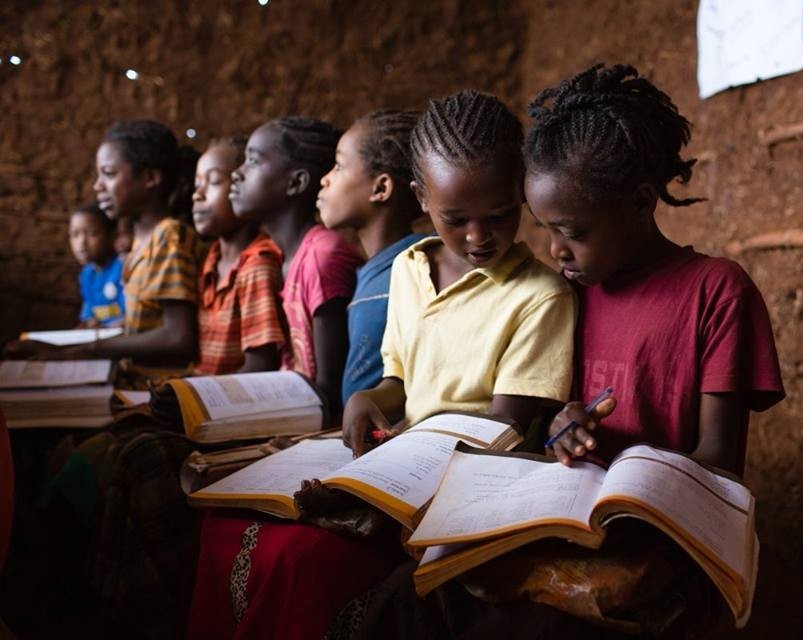
CEGA’s Psychology and Economics of Poverty (PEP) Collaborative hosted its second annual convening on Friday, May 17th, 2019 at UC Berkeley.

Faculty and graduate students from the disciplines of psychology and economics shared research advancing our understanding of the causes and consequences of poverty. By merging insights from the traditionally independent fields of social and developmental psychology, behavioral economics, and public policy, we aimed to explore how scarcity and uncertainty affects cognition as well as mental health, beliefs, aspirations, and economic decision-making. Building on the momentum from our inaugural event, the convening highlighted exciting new research while strengthening a growing, interdisciplinary community of practice in this space.
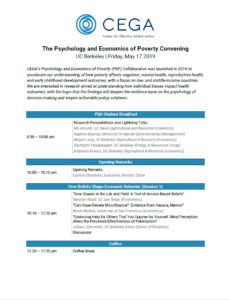
Agenda

Speakers denoted by italics and an asterisk. Co-authors listed in alphabetical order denoted by †. Please find a PDF of the agenda linked here as well as slides and recordings linked below.

Read a summary of key takeaways from the event here.

PhD Student Breakfast – Research Presentations and Lightning Talks

Economic Shocks and Personality Traits of the Ultra Poor

Mo Alloush, UC Davis (Agricultural and Resource Economics)

Dynamics of Culture on Environmental Sustainability: A Case Study of Sub-Saharan Africa

Raphael Ebanda, University of Nairobi (Environmental Management)

Gender Identity Norms and Psychological Well-being

Megan Lang, UC Berkeley (Agricultural & Resource Economics)

Evaluation of Social Networks and Measures of Empowerment among Adolescent Girls in Uttar Pradesh, India

Gauthami Penakalapati, UC Berkeley (Energy & Resources Group)

Exploring Taxation Toward Representation: Public Goods, Tax Collection, Social Norms, and Democratic Accountability

Benjamin Krause, UC Berkeley (Agricultural & Resource Economics)

Session 1 – How Beliefs Shape Economic Behavior

Sour Grapes in the Lab and Field: A Test of Access-Based Beliefs

Vinayak Alladi, UC San Diego (Economics)*

Slides

Can Hope Elevate Microfinance? Evidence from Oaxaca, Mexico

Bruce Wydick, University of San Francisco (Economics)* Travis Lybbert, UC Davis, Irvin Rojas, CIDE

Slides

Endorsing Help for Others That You Oppose for Yourself: Mind Perception
Alters the Perceived Effectiveness of Paternalism

Juliana Schroeder, UC Berkeley (Haas School of Business)*, Nicholas Epley, University of Chicago, Adam Waytz, Northwestern University

Slides

Session 2 – How Economic Insecurity Affects Growth and Development

Isolating the Effects of Developmental Food Insecurity on Learning, Cognitive Flexibility, and Addiction Related Behavior in Adulthood

Linda Wilbrecht, UC Berkeley (Psychology)*

Poverty, Seasonal Scarcity and Exchange Asymmetries: Evidence from Small-Scale Farmers in Rural Zambia”

Kelsey Jack, UC Santa Barbara (Environmental Science & Management)*, Dietmar Fehr, University of Heidelberg, Günther Fink, University of Basel

Slides

Socio Economic Status and Attention Capture: Educational Impacts

Claire Duquennois, UC Berkeley (Agricultural & Resource Economics)*

Session 3 – How Changes in Income Influence Psychology

The Effects of Federal and State Earned Income Tax Credits on Mental
Health and Health Behaviors

Rita Hamad, UC San Francisco (Health Policy and Family Medicine)*

The Impact of Direct Giving on People Experiencing Homelessness:
Experimental Evidence From Vancouver, Canada

Jiaying Zhao, University of British Columbia (Psychology)*

Economic Shocks and Personality Traits of the Ultra Poor

Shikhar Mehra, University of San Francisco (Economics)

Slides

Session 4 – How Scarcity Affects Decisionmaking

What Accounts for Socioeconomic Differences in Child-Directed Speech?The Role of Resource Scarcity”

Monica Ellwood-Lowe, UC Berkeley (Psychology)*

Slides

Does Financial Strain Lower Productivity?

Supreet Kaur, UC Berkeley (Economics)*, Suanna Oh, Columbia University, Sendhil Mullainathan, University of Chicago, Frank Schilbach, MIT

Slides

How robust are scarcity inductions? Undertaking well-powered
replications of a systematic sample of recent literature

Ruthe Foushee, UC Berkeley (Psychology)

Slides

Areas of work
Health & Psychology